The Dark Night of the Soul
Understanding a Deep Inner Passage
There are periods in life when everything seems to go out inside.
No more joy, no more momentum, no more meaning.
What helped you hold on yesterday no longer works today, for no obvious reason.
This experience is often called the dark night of the soul.
It is neither a weakness nor a failure, but a deep inner passage, sometimes disorienting, sometimes frightening, which deserves to be understood and supported with great discernment and gentleness.
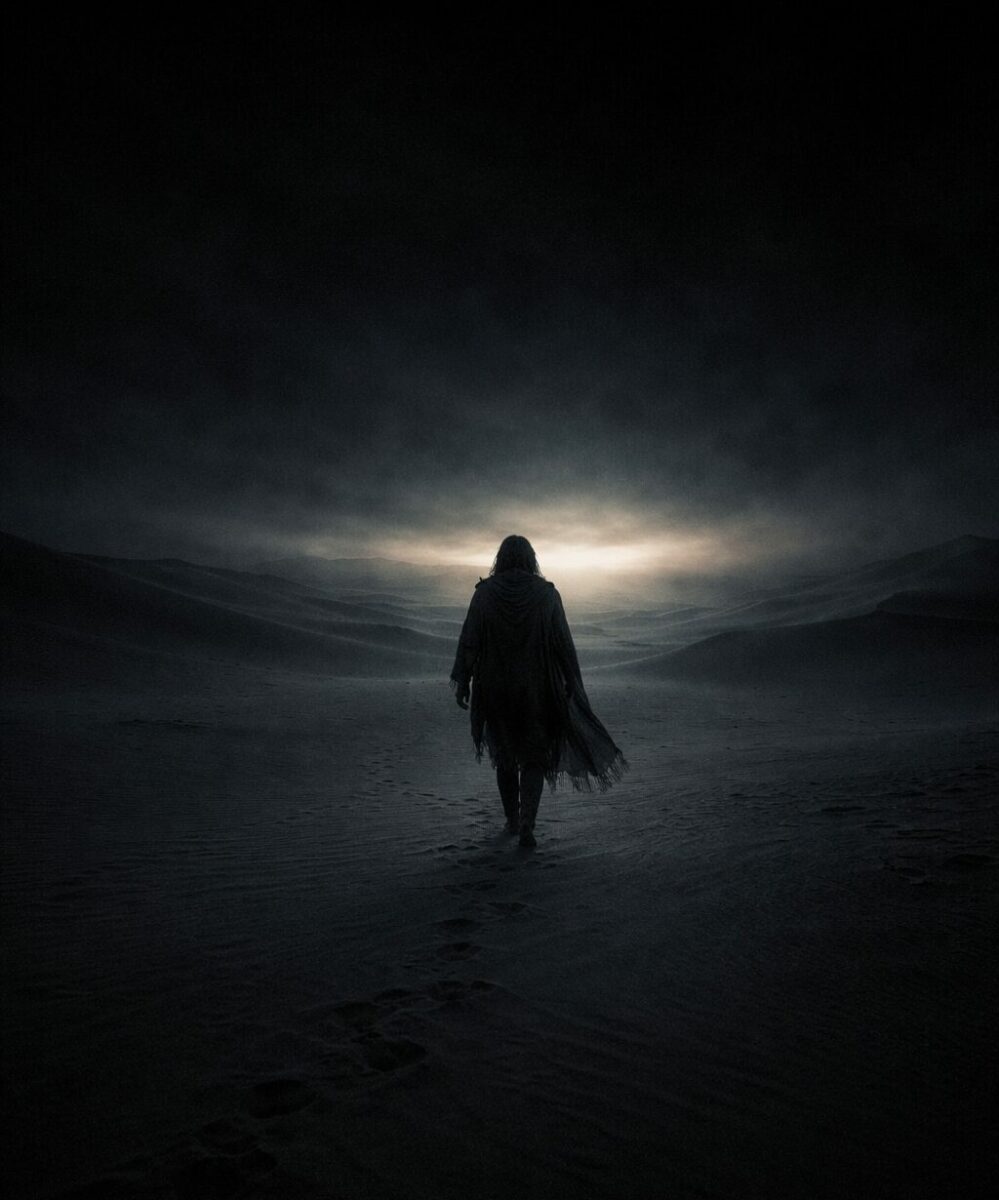
When there is nothing left to hold on to, the soul walks in silence.
It is there, in the heart of the void, that a new light begins to emerge, soft, slow and irreversible ✨
The origin of the expression “the dark night of the soul”
The expression originated in the 16th century with John of the Cross, a Spanish mystic and poet.
In his work Dark Night of the Soul, he describes an intense spiritual experience marked by a feeling of abandonment, emptiness and absence of God.
For him, this night is not a punishment.
It is a phase of stripping away, where old beliefs, familiar reference points and sources of comfort disappear in order to allow a deeper transformation of the being.
Over time, the expression moved beyond the purely mystical field to describe major existential crises, where psychological, emotional, bodily and spiritual dimensions intertwine.
What we call the dark night of the soul today
The dark night of the soul can be understood as a disintegration of the former self.
A form of collapse of the ego, of the constructed identity, of what had until then allowed you to define yourself and keep going.
It often manifests as:
- a shutdown of the body, heart and soul
- extreme, sometimes overwhelming fatigue
- a radical loss of meaning
- a deep doubt towards oneself, life, God or the Universe
- a feeling of inner emptiness or disconnection
- an inability to imagine the future
For some people, this passage may be accompanied by suicidal thoughts.
In this case, it is essential not to remain alone and to ask for help immediately. This is not a spiritual subject to go through in isolation, but a warning signal that calls for concrete and human support.
In France, 3114 is the national suicide prevention number, available 24/7.
In case of immediate danger, call 15 or 112.
If you are outside France, please reach out to the suicide prevention or crisis support service available in your country. In the United States and Canada, 988 is available for suicide and crisis support. In the UK and Ireland, Samaritans can be reached at 116 123. You can also use Find A Helpline to locate emotional support services worldwide.
If there is an immediate risk to your safety, please contact your local emergency number without delay.

Inner chaos, when everything collapses
The dark night is often accompanied by a state of inner chaos.
Chaos is not meaningless destruction, but a phase of transition. The old internal system collapses before the new one has yet taken shape.
In chaos:
- reference points disappear
- emotions overflow or shut down
- the mind can no longer understand
- the body is simply trying to survive
This chaos gives the impression of an ending.
Yet it is often the sign of a deep reconfiguration, still invisible.
Triggers, when an event acts as a detonator
The dark night of the soul is often triggered by an intense emotional shock:
- a romantic separation
- a death
- a betrayal
- an illness
- prolonged exhaustion
It is not so much the event itself as its ability to reactivate repetitive wound patterns: abandonment, rejection, humiliation, injustice, betrayal.
These events act as detonators for older memories, sometimes transgenerational or karmic.
The ego, which had until then maintained a certain balance, collapses under the weight.
Warning signs and the dark night, an essential difference
It is important to distinguish the warning signs from the dark night itself.
Before the collapse, we often observe:
- repeated activation of survival mechanisms, fight, flight, freeze
- fatigue that no longer recovers
- sleep disturbances
- emotional hypersensitivity
- constant rumination
- repetition of painful relationship patterns
- a gradual loss of creative joy
The dark night corresponds to the moment when the system can no longer compensate.
It no longer fights, it shuts down. This is the shutdown.
Listening to the warning signs can sometimes help avoid an overly extreme passage.
The Shadow is not an enemy
Carl Jung spoke of a descent into the Shadow.
The Shadow is not what is bad, but what has been denied, repressed or forgotten.
In the dark night, the Shadow rises to the surface.
Not to destroy, but to reconnect you with an inner truth that had been left aside.
When it arrives without a framework or support, it overwhelms.
When it is welcomed and brought into consciousness, it transforms.
The role of the nervous system
On a physiological level, the dark night often corresponds to overheating followed by a collapse of the nervous system.
After carrying too much, holding on too much, enduring too much, the body has no other option than to enter maximum energy conservation.
It is a survival mechanism, not a lack of willpower.
Understanding this allows you to step out of guilt and adopt a softer approach that respects your rhythm.
The importance of medical and therapeutic support
It is essential not to spiritualise suffering at the expense of the body.
Nutritional deficiencies, hormonal imbalances, chronic inflammation or deep exhaustion can amplify emotional and psychological vulnerability.
A medical check-up, psychotherapeutic support or psychiatric care are not incompatible with a spiritual path.
They can be precious supports to go through this passage without losing yourself.
A passage that can unfold over time
Contrary to what its name may suggest, the dark night of the soul does not last one night.
It can unfold over weeks, months, sometimes years, often in waves.
There are periods of soothing, then returns, successive realisations, inner griefs to integrate.
It is a path of maturation, not a one-time event.
Shifts, healing sessions and opening to the subtle
Along this path, there may be shifts, deep changes in perception. They can occur after energy healing, regressive hypnosis, bodywork or therapeutic work.
A contemporary metaphor illustrates this dynamic particularly well: the novel The Midnight Library by Matt Haig. The main character, Nora Seed, first goes through an inner collapse marked by a total loss of meaning and an existential shutdown. The library is not a magical solution to her suffering, but a symbolic space, an in-between, where she explores potential lives and gradually deconstructs the narratives of the ego, regrets and illusions of control.
Each alternative life acts as a mirror, revealing that it is not an ideal life that heals, but a transformation in the way one looks at oneself and at the experience of being alive. This passage accurately illustrates the heart of many dark nights of the soul: a disidentification from the former self followed by a fragile, humble and embodied re-adhesion to life.
These experiences are not miracles. They are often punctual accelerations within a wider process of inner maturation.
Some people also describe an increased opening to the subtle: a finer intuition, synchronicities, sometimes the emergence of new abilities or perceptions. These openings always need to be integrated with discernment, grounding and support.
An ethical posture
I am not a saviour.
I am not here to replace a doctor, psychologist or psychiatrist.
My role is to accompany, support, release charges, and help bring movement back where everything has become frozen, in complementarity with other forms of support.
The work is done step by step, consciously, with respect for each person’s rhythm.
An ending that is not really an ending
The dark night of the soul is not an end.
It is often the end of an old version of the self that can no longer contain what the being is becoming.
Even though it is painful, it can become a passage towards more authenticity, truth and inner alignment.
If you are going through this period, know that you are not alone, and that asking for help is an act of courage.
When the body asks to be supported more deeply
During the dark night of the soul, some people already put in place practices of regulation, awareness or soothing.
This can bring real relief, sometimes temporarily.
But sometimes, despite this, reactions return, intensify or settle over time.
Persistent fatigue, unstable emotional states, sensations of shutdown, repeated patterns or sudden reactivations.
When this happens, it is not a failure of the path.
It often indicates that the nervous system and the body are carrying deeper memories, sometimes old, sometimes unconscious, that are asking to be recognised and released with more precision and gentleness.
In these moments, the body is not resisting.
It is simply signalling that the work is taking place on another level than the mind or willpower alone.
Understanding the origin of patterns with the Akashic Records
Akashic Records readings bring clarity where the mind can no longer understand.
They offer insight into the origin of repetitive patterns and active memories, whether personal, transgenerational or karmic.
Bringing meaning to what is being replayed, understanding why certain wounds reactivate with such intensity, often allows a first soothing of the system.
Understanding is not about over-analysing, but about restoring inner coherence during a period when everything feels fragmented.
Light Language, regulation through the voice, rhythm and the energy system
During the dark night of the soul, the body and nervous system are often too saturated to go only through words or reflection.
Light Language healing sessions then work on another level.
Through the vibration of the voice, rhythm and frequencies, they directly support the nervous system and the energy body, encouraging deep relaxation, emotional release and a gradual return to a feeling of inner safety.
The body does not need to understand anything.
It receives, it releases, it regulates at its own rhythm.
Combined healing sessions, linking understanding and release
Combined sessions bring these two approaches together.
They allow the conscious mind, the unconscious and the body to be supported at the same time within a global process of regulation.
Understanding supports release.
Release allows understanding to integrate without forcing.
These forms of support are not intended to provoke rapid change or to “pull someone out” of the dark night.
They aim to accompany the body and the soul where they are ready to let go, at their own rhythm, in respect of their natural intelligence and limits.
Sources and references
The reflections shared in this article are inspired by several spiritual, psychological and somatic approaches that explore inner transformation, shadow work, the nervous system and spiritual crisis.
- John of the Cross,
The Dark Night, 16th century
A foundational text for the notion of the “dark night of the soul”, describing a spiritual passage of stripping away, inner emptiness and loss of reference points as a stage of deep transformation. - Carl Gustav Jung,
Man and His Symbols and
Psychology and Alchemy
Jung’s work on the Shadow offers a valuable psychological framework for understanding the descent into unconscious material and the process of psychic reintegration. - Stephen Porges,
The Polyvagal Theory
His research on the autonomic nervous system helps illuminate survival states such as freeze, shutdown and collapse, which may appear during periods of extreme stress or loss of meaning. - Stanislav Grof,
Spiritual Emergency
His work explores spiritual and transpersonal crises that may arise during deep transformation, and the importance of distinguishing them from purely pathological experiences. - Matt Haig,
The Midnight Library
A contemporary novel that symbolically illustrates a major existential crisis close to the dark night of the soul, where transformation comes through a renewed relationship with life itself.